Why Can You Focus When Someone's There (But Not Alone)?
Body doubling sounds too simple to work. But ADHD brains focus better with another person nearby. Here's the science and how to try it today.

Here's something weird about my brain that I didn't understand for years:
I can sit alone in my apartment for six hours, staring at a task I desperately need to do, completely unable to start. Paralyzed. Scrolling. Getting up for snacks I don't want. Reorganizing a drawer that didn't need reorganizing.
But put me in a coffee shop — surrounded by strangers, noise, distractions everywhere — and suddenly I can work for three hours straight.
Or: my friend comes over to "keep me company" while I clean. She's just sitting on my couch, reading her phone, not helping at all. And somehow I blast through the entire apartment in 45 minutes.
Same brain. Same tasks. The only difference? Another person in the room.
For years I thought this was some kind of codependency thing. Like I was too needy to function alone. (The shame spiral was impressive — I could turn anything into evidence that I was broken.)
Then I learned the term for it: body doubling. And I learned it's one of the most well-known, widely-used strategies in the ADHD community. Not a character flaw. A technique. One with actual neuroscience behind it.
What body doubling actually is
The concept is almost embarrassingly simple: you do your task while another person is present. They're not helping you. They're not supervising you. They're not even necessarily doing the same thing. They're just... there.
Your "body double" might be:
- A friend sitting in your living room doing their own thing while you clean
- A partner working on their laptop at the same table while you pay bills
- A coworking session over video call with someone across the world
- A library full of people quietly working
- A "study with me" livestream playing on your screen
The other person's presence — real or virtual — acts as an anchor for your attention. That's it. That's the whole trick. And for ADHD brains, it can be the difference between six hours of paralysis and 45 minutes of flow.
Why it works (the brain stuff, kept simple)
I'm not a neuroscientist, so here's my plain-English understanding, pieced together from what clinicians and researchers describe:
ADHD brains are under-stimulated at baseline. We're running on low dopamine, which means boring tasks feel physically painful to start — not metaphorically, but in the same brain circuits that process reward and motivation. Alone in a quiet room, there's nothing to nudge your nervous system into "go" mode.
Another person's presence provides just enough external stimulation — a low hum of social accountability, a subtle sense of being "on" — to lift your arousal to the level where starting becomes possible. It's not pressure. It's not judgment. It's like... background music for your nervous system.
There's also something about witnessed time. Alone, time is abstract and slippery (hello, time blindness). With someone else there, there's a gentle social container around the time — it has edges. You're less likely to drift because some part of your brain registers: someone is here, this is work time.
Researchers describe it as "externalizing" executive function — borrowing someone else's regulated nervous system to stabilize your own. You know how a calm person can calm you down just by being calm near you? Same principle, applied to focus.
Is the science settled? Honestly, no — it's an area where lived experience is ahead of formal research. But the lived experience is overwhelming. Ask any ADHD community and body doubling is one of the first strategies mentioned. Sometimes the people living it know before the studies catch up.
How to actually do it
Okay. Theory's nice. Here's the practical part — how to build body doubling into your real life, even if you live alone and your friends are busy.
The low-tech version: use the people you have
The parallel hangout. Next time a friend suggests coffee, try this instead: "Want to come over? I need to clean and I work better with someone around. You don't have to help — just bring your laptop." Most people are delighted. It feels like hanging out. It is hanging out. You're just also getting stuff done.
I do this with my sister monthly. She brings her knitting, I tackle whatever household nightmare I've been avoiding. We chat a little, work a lot. It's my favorite appointment on the calendar.
The public place trick. Coffee shops, libraries, coworking spaces — anywhere with ambient human presence. I wrote most of my book in a specific corner of a specific café, surrounded by strangers. Something about being seen working (even by people who don't care) keeps me anchored.
The partner/family version. "I'm going to pay bills at the kitchen table for the next 30 minutes — can you just be nearby?" You'd be surprised how willing people are. Frame it as togetherness, not neediness. Because it is togetherness.
The virtual version: body doubles on demand
This is the game-changer for those of us who live alone, work odd hours, or feel awkward asking.
Focusmate. This is the big one — a service that pairs you with a stranger for 50-minute coworking video sessions. You state your goal at the start, work silently with cameras on, report back at the end. It sounds terrifying. It's actually wonderful. The mild social accountability of a stranger expecting you to report back is incredibly effective. (Not sponsored — I just genuinely use it.)
"Study with me" videos. YouTube is full of them — hours-long videos of someone quietly studying, sometimes with a Pomodoro timer built in. Put one on your second monitor or tablet. Your brain registers the presence. It shouldn't work. It does.
Discord and online ADHD communities. Many have dedicated body doubling channels or scheduled coworking sessions. The ADHD community online is warm, funny, and completely free of judgment. Find your people.
A plain video call. Honestly? Call a friend, both mute, both work. My friend and I do "parallel work calls" twice a week. We wave at the start, work for an hour, wave at the end. It's the most productive hour of my week, every week.
Make it a ritual, not a rescue
Here's the mistake I made at first: I only used body doubling when I was already in crisis. Drowning in tasks, paralyzed for days, then I'd desperately text someone.
It works much better as prevention. I now have two scheduled body doubling sessions per week — same times, non-negotiable, like appointments. Tuesday morning: admin and bills with my Focusmate partner. Thursday evening: household stuff with my sister (virtual or in person).
Scheduled > desperate. Always. Put it on the calendar before you need it.
What body doubling is NOT
A few things worth clarifying, because I misunderstood all of these at first:
It's not supervision. Your body double isn't checking your work or keeping you accountable in a boss-like way. If someone starts managing you, that's not body doubling — that's just annoying.
It's not codependency. Needing the right conditions to function isn't weakness. A nearsighted person isn't "dependent" on glasses. You're not dependent on people — you're using an environmental strategy. There's a difference, and it matters.
It's not the only tool. Body doubling is fantastic for starting and staying on tasks. It doesn't help you decide what to do (that's what the top-three list is for) or manage your time (hello, timers). It's one tool in the kit — a powerful one, but one.
The deeper truth
Here's what body doubling taught me about myself, beyond the productivity hack:
I'd spent years believing I was someone who "couldn't work alone" — framing it as a deficiency. What I actually am is someone whose nervous system co-regulates with other people's presence. That's not a flaw. It's human. We're social animals. Some brains just need the social channel open to function at their best.
There's a quiet grief in realizing how many years you white-knuckled through things alone, thinking you should be able to do it solo. And there's a quiet joy in discovering that the answer was never "try harder alone" — it was "stop doing it alone."
You don't have to earn the right to need people. You just... need people. We all do. Some of us just need them in the room while we do our taxes.
Go deeper
Body doubling is Chapter 12 of my book — with scripts for asking (because "can you just sit near me while I work?" feels weird the first time), a guide to virtual options, and worksheets for building your weekly doubling schedule.
→ Get The Late-Diagnosed Woman's ADHD Guide on Amazon
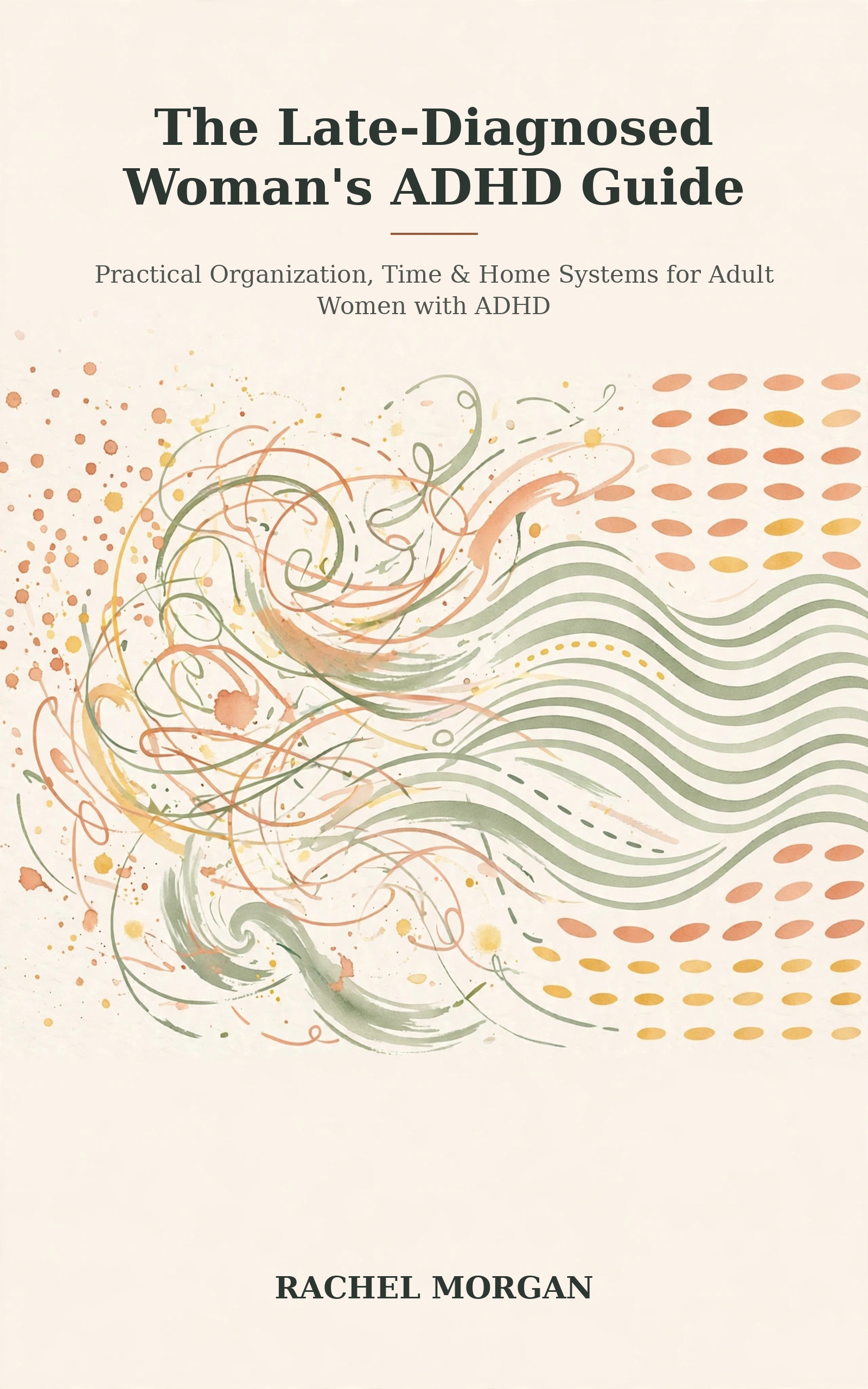
Want the full system?
My book The Late-Diagnosed Woman's ADHD Guide has 20 chapters of practical systems, 14 worksheets, and a 30-day reset plan — written by someone who lives this.
Get the book on Amazon Download Chapter 1 freeFAQs
Does body doubling work if the other person is a stranger?
Yes — often better than with close friends, because there's less temptation to chat. Services like Focusmate work precisely because the mild accountability of a stranger is powerful without being emotionally complicated.
What if I'm an introvert? Does this still apply?
Absolutely. Body doubling doesn't require interaction — that's the beauty of it. Many introverts with ADHD prefer silent body doubling (library, virtual coworking with cameras on but muted). Presence without socializing is the sweet spot.
Can I body double with my kids or partner?
Yes, with realistic expectations. A partner reading nearby while you work counts. Kids doing homework at the same table while you pay bills counts. It doesn't have to be serene — it just has to be present.
Is there scientific research supporting body doubling?
Formal research is still catching up, but the mechanism aligns with established neuroscience on social co-regulation, externalized executive function, and dopamine-mediated motivation in ADHD. Clinicians widely recommend it, and the anecdotal evidence from the ADHD community is extensive and consistent. ---

Rachel Morgan was diagnosed with ADHD at 34, after decades of wondering why everything felt harder for her. She writes practical, shame-free systems for women whose brains work differently — from the book The Late-Diagnosed Woman's ADHD Guide.
This site shares personal experiences and general information, not medical advice. Please consult a qualified professional for diagnosis or treatment.