Is Your Mess a Brain Problem, Not a Character Flaw?
Forget Marie Kondo. ADHD brains need a completely different way to declutter. Here's the system that works when nothing else has.

Let me describe my apartment, circa age 29:
The kitchen counter had a "system." I put that in quotes because it wasn't a system, it was archaeology. Layers. Mail from three months ago forming the bedrock, with newer strata of unopened packages, dead batteries, and — I kid you not — a single oven mitt that had migrated there from God knows where and achieved permanent residency.
The bedroom chair. You know the chair. Every ADHD woman has the chair. Mine held approximately fourteen items of clothing in various states of clean, arranged in what I told myself was "a system" (it was not a system).
The bathroom drawer contained, among other mysteries, nine lip balms. Nine. I could only ever find one at a time, so I'd buy another. The drawer was a lip balm farm.
And the shame — God, the shame. Because I knew how to clean. I'd read the books. I'd watched the shows. Marie Kondo told me to hold each item and ask if it sparked joy, and I stood there holding a broken phone charger from 2016 feeling absolutely nothing except the familiar certainty that I was fundamentally defective.
Here's what I know now: I wasn't defective. I was trying to use a neurotypical organizing system on an ADHD brain. That's like trying to run Mac software on a Windows machine and concluding the computer is broken.
Why normal decluttering advice fails ADHD brains
Let's be honest about what traditional organizing advice assumes:
It assumes you can hold a vision of the finished room in your head while working. ADHD working memory says: absolutely not. You start "cleaning the bedroom," find an old photo album, spend 40 minutes looking through it, and emerge with the room messier than when you started. (This has happened to me more times than I can count. The photo album is a trap.)
It assumes you can make hundreds of micro-decisions without depleting. Keep or toss? Where does this go? What about this? Each decision costs mental energy, and ADHD brains run out faster. By decision number thirty, you're sitting on the floor surrounded by piles, crying, eating crackers straight from the box. Ask me how I know.
It assumes "a place for everything" works when you can't remember the places. Out of sight is literally out of mind for us. The beautiful closed storage systems — the ones with the matching bins behind cabinet doors — are where ADHD items go to die. If I can't see it, it doesn't exist. That includes the expensive planner I bought, put "somewhere safe," and found two years later.
It assumes motivation follows intention. "Just spend 15 minutes a day tidying!" Sure. And I'll "just" remember to do it, "just" start on time, "just" not get distracted halfway through. The word "just" is doing so much work in that sentence.
None of this is a willpower problem. It's an executive function problem. And once I understood that, I could stop trying to force myself into systems designed for other brains and start building ones for mine.
The ADHD way to declutter
Forget everything Marie Kondo told you. (No disrespect to Marie — her method is beautiful. It's just not built for us.) Here's what actually works:
Rule 1: If you can't see it, it doesn't exist
This is the foundational principle. Everything else follows from it.
Open storage over closed storage. Clear bins, open shelves, hooks on walls, things out on counters (in designated spots). I know it looks less "clean" than everything hidden away. But hidden-away means forgotten, and forgotten means rebuying the thing you already own, which means more clutter. Visible is better. Always.
My kitchen now has open shelving for the stuff I use daily. Is it magazine-beautiful? No. Do I actually use everything on those shelves instead of forgetting it exists? Yes. That's the trade, and it's worth it.
Labels on everything. Not cute chalkboard labels (unless that motivates you — no judgment). Just a label maker or masking tape and a marker. "BATTERIES." "CABLES." "RANDOM BUT IMPORTANT." The label is an external memory. Your brain doesn't have to hold "where do batteries go" anymore. The bin tells you.
The launch pad principle, everywhere. Remember the launch pad from the morning routine? Apply it to every category. Keys have a home (a hook by the door — the only home keys are allowed to have). Mail has a home (one tray, processed weekly). Bags have a home. Everything you touch daily gets a visible, labeled, non-negotiable home.
Rule 2: The one-touch rule (modified for real life)
The classic advice: "Only handle it once! When you pick something up, put it where it belongs immediately!"
In theory: beautiful. In ADHD practice: you'll put it down "just for a second" and find it in six weeks.
Here's my modified version — the "touch it with intention" rule: when you pick something up, you have two legal moves. Put it in its home, or put it in the transition bin. That's it. No third option of "set it down here temporarily," because "temporarily" is where things go to die.
The transition bin is the secret weapon. One bin — just one — per main area. Anything that doesn't have an obvious immediate home goes in the transition bin. Not on the counter. Not on the chair. In the bin.
Then, once a week (I do Sunday evenings, anchored to making tea), you process the transition bin. Fifteen minutes. Everything in it either finds a home or leaves the house. The bin contains the chaos so the chaos doesn't contain you.
This works because it respects how ADHD brains actually function. We're not going to perfectly put everything away in real time — that's a fantasy. But we can learn one habit: "doesn't have a home right now → transition bin." One decision instead of forty.
Rule 3: Declutter in sprints, not marathons
"Clean the whole house Saturday" is a fantasy that ends in tears and a half-destroyed living room. (I've lived this. The living room looked worse at 6 PM than at 9 AM. I ordered pizza and pretended the piles were furniture.)
Instead: 15-minute sprints. Set a visual timer (see the time blindness article — same principle). Pick ONE tiny area. Not "the bedroom" — "the top of the dresser." Not "the kitchen" — "one shelf of the pantry."
When the timer dings, you stop. Even mid-pile. Especially mid-pile. Walk away. The pile will be there tomorrow, and you'll attack it fresh instead of spiraling.
Why this works: ADHD brains can do almost anything for 15 minutes. It's the open-ended nature of "clean the house" that triggers shutdown. A sprint has edges. Edges make it safe to start.
And here's the magic: most of the time, when the timer dings, you'll keep going for another few minutes because you're in motion now. Starting was the hard part. The timer just tricks you past the starting line.
Rule 4: Categories, not rooms
Don't declutter room by room. Your brain doesn't organize by room — it organizes by category, and fighting that is exhausting.
Instead, pick a category and hunt it through the whole house: "Today I'm dealing with all the chargers and cables." Gather every cable from every room into one pile. Then sort: keep (label them! — masking tape and a marker, "phone," "laptop," "mystery"), toss (the broken ones, the ones for devices you haven't owned since 2019), donate.
One category at a time. It feels weird at first — "but the bedroom still looks terrible!" — but it's actually faster, because you're making one type of decision repeatedly instead of switching decision-types every thirty seconds. Decision-switching is expensive for ADHD brains. Batch the decisions.
Rule 5: The "good enough" standard
Perfectionism is the enemy of done. I know, because I'm a recovering perfectionist whose "recovery" is very much in progress.
Your home doesn't need to look like a magazine. It needs to function. Can you find your keys? Can you cook a meal without excavating the counter first? Can you have someone over without a three-hour panic clean? That's the bar. "Good enough to live in" beats "perfect for one day then chaos again" every single time.
I have a sign on my fridge — handwritten, crooked — that says: "Done is better than perfect. Functional beats beautiful." I need the reminder. Maybe you do too.
The emotional part (because there's always an emotional part)
Can we talk about what clutter means for a minute? Because it's never just stuff.
Every pile is evidence. Evidence that you can't get it together. Evidence that you're failing at the basic adult task of maintaining a home. When someone comes over unexpectedly and you see your space through their eyes, the shame is physical — hot face, stomach drop, the frantic mental calculation of which rooms you can block off.
I've cancelled plans because my apartment was too messy for visitors. Not "a bit untidy" — the kind of messy that felt like it revealed something true about me. Like if they saw the chair, they'd know. Know what? That I'm a fraud? That the competent exterior is a lie?
Here's what I want you to hear: your worth was never measured in tidy counters. The mess is a symptom of an executive function difference, not a moral report card. You wouldn't shame someone for needing glasses to read. Stop shaming yourself for needing systems to organize.
And when you start building those systems — the visible storage, the transition bins, the 15-minute sprints — and they actually work, something shifts. Not just the apartment. You. Because every time a system works, it's evidence for a new story: I'm not broken. I just needed different instructions.
Start small. Start today.
Don't declutter the house. Declutter one drawer. The junk drawer — everyone has one, it's the perfect first target. Set a timer for 15 minutes. Toss the obviously dead stuff (dried-out pens, expired coupons, the manual for something you don't own). Put the keepers in a tray. Label it if you're feeling fancy.
One drawer. That's a complete, valid victory. Celebrate it like one.
Then tomorrow, maybe, another drawer. Or the top of the dresser. Small wins compound. Six months of 15-minute sprints will transform a home more than any single heroic cleaning day ever could. I know, because I lived both versions.
Go deeper
The complete home system — zone-by-zone setup guides, the full transition bin method, worksheets for designing your space around your brain — is in Chapters 8-11 of my book.
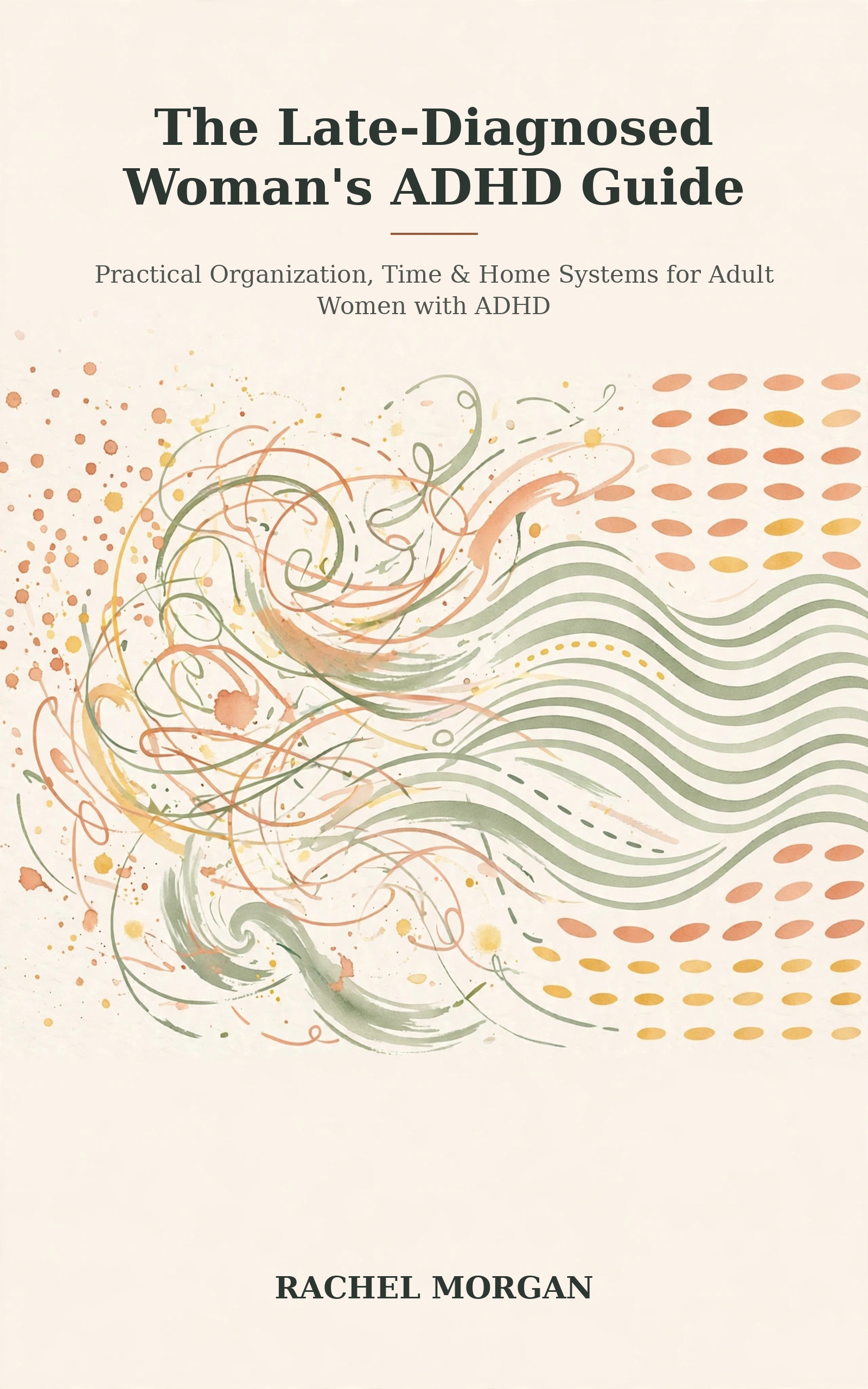
→ Get The Late-Diagnosed Woman's ADHD Guide on Amazon
Want the full system?
My book The Late-Diagnosed Woman's ADHD Guide has 20 chapters of practical systems, 14 worksheets, and a 30-day reset plan — written by someone who lives this.
Get the book on Amazon Download Chapter 1 freeFAQs
Why doesn't the KonMari method work for ADHD?
KonMari asks you to hold every item and assess whether it "sparks joy" — hundreds of individual emotional decisions in sequence. For ADHD brains, this causes rapid decision fatigue. It also assumes you'll maintain the system through consistent habits, which is exactly where executive dysfunction hits hardest. The method isn't bad — it's just not designed for our brains.
Should I get rid of everything and start over?
Tempting, but no. Dramatic purges feel satisfying for about a week, then the clutter creeps back because the systems haven't changed. It's better to declutter gradually while building sustainable systems — visible storage, transition bins, regular sprints. Fix the system, not just the symptom.
What about sentimental items? I can't throw away anything emotional.
You don't have to. Create a designated "memory box" (or two — be honest with yourself about the limit) for sentimental items. They get a home like everything else. The goal isn't minimalism — it's intentionality. Keep what matters. Just give it a visible, labeled place to live.
My partner/family doesn't have ADHD and thinks I'm just lazy. How do I handle that?
This is painful and common. The book includes specific scripts for these conversations (Chapter 18). The short version: explain executive dysfunction as a neurological difference, not a choice — and invite them to be part of building systems rather than judging the lack of them. Many partners become allies once they understand it's brain wiring, not character. ---

Rachel Morgan was diagnosed with ADHD at 34, after decades of wondering why everything felt harder for her. She writes practical, shame-free systems for women whose brains work differently — from the book The Late-Diagnosed Woman's ADHD Guide.
This site shares personal experiences and general information, not medical advice. Please consult a qualified professional for diagnosis or treatment.